Need to open a Keynote presentation in Google Slides? Since Google Slides doesn’t support .key files directly, you’ll first need to convert the presentation into a compatible format like PPTX. In this guide, I’ll show you the easiest ways to convert Keynote to Google Slides on Mac, Windows, and iCloud without losing formatting.
Why I Needed to Transfer Keynote to Google Slides?
I normally create presentations on my Mac using Keynote because of its clean interface. But whenever I collaborate with teams using Google Workspace, I have to convert my Keynote files so everyone can edit them online.
Not only this, but there are some more reasons to perform this task, i.e.
- Sharing presentations with non-Mac users
- Collaborating in real-time on Google Slides
- Presenting using Google Meet
- Storing slides in shared Google Drive folders
- Keeping everything on the cloud so it can be accessible from any device or location
If you’re in a similar situation, follow the steps discussed in the sections below.
Related guide: How to Make Google Slides Vertical?
How to Convert Keynote to Google Slides?
As I mentioned, I use my Mac to make slides via Keynote. But when it comes to collaboration, I need Google Slides. So, that’s why I used these solutions, and you can opt for any according to your needs. Let me explain one by one:
#Method 1. Transfer Keynote to Google Slides Using a Mac
If you already have access to Keynote on macOS, this is the most reliable option. I use this method most of the time. Here are the steps of the same:
- Launch Keynote and open your .key presentation.
- Google Slides doesn’t support .key files directly. So export the file to Microsoft PowerPoint (.pptx) format. Then:
- Go to File > Export To > PowerPoint
- Click Next
- Choose location > Click Export
- Now, upload the PPTX File to Google Drive:
- Open Google Drive
- Click New > File Upload
- Select the exported .pptx file
- Open the File With Google Slides:
- Right-click the uploaded file > choose Open with > Google Slides
Google Slides will automatically convert the PowerPoint file to a Google Slides format. This solution maintains the keynote formatting intact.
#Method 2. Convert Keynote to Google Slides Using iCloud
This is a method I personally like because it uses Apple’s own cloud version of Keynote.
- Go to iCloud.com
- Sign in with your Apple ID
- Open Keynote
- Click the Upload icon
- Select your Keynote file
- Once the file opens:
- Click the Wrench icon (Settings)
- Choose Download a Copy
- Select PowerPoint (.pptx)
- Upload the PPTX file to Google Drive and open it with Google Slides.
Also read: How to convert PPT to Google Slides
#Method 3. Use Google Drive to Convert Directly Only for PPTX
Google Drive cannot directly convert .key files, but it can convert PPTX. If someone sends you a Keynote file, ask them to export it as PowerPoint first. Then:
- Upload PPTX > Open in Google Slides > Done.
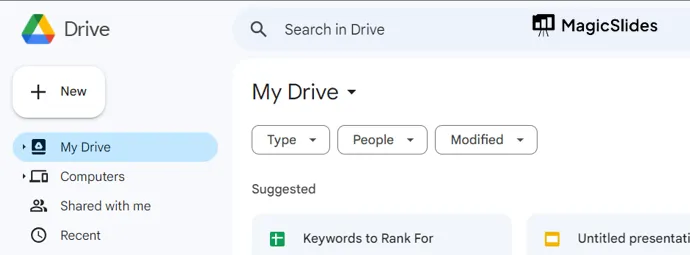
- Once the file is uploaded, right-click on it and choose Open with > Google Slides.
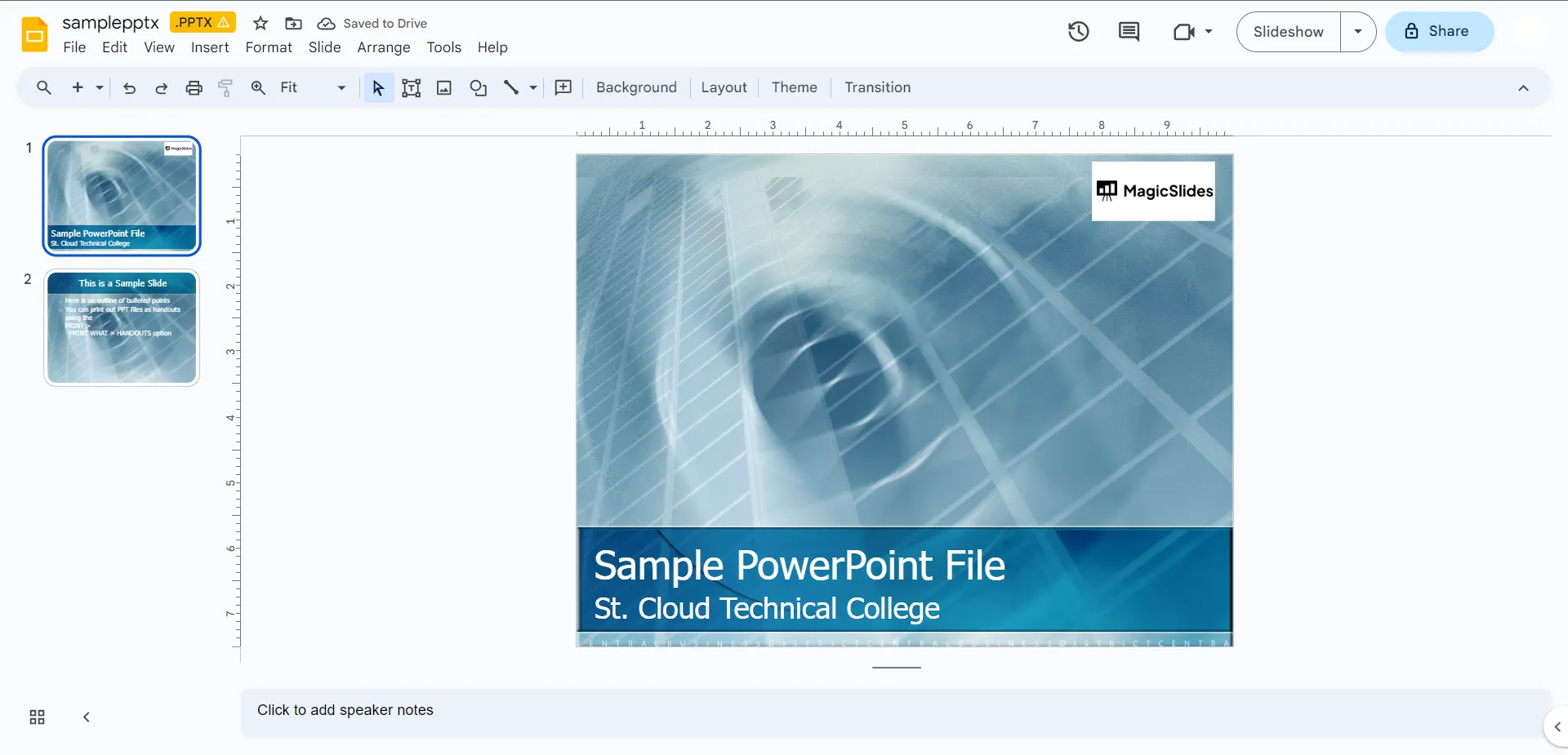
This is a quick and straightforward solution to convert Keynote to Google Slides.
#Method 4. Recreate Your Keynote in Google Slides
If you don’t have access to a Mac and you want a clean Google Slides version of your Keynote file, one of the easiest methods I use is MagicSlides AI PPT Maker. Instead of converting the .key file directly, which is almost impossible on Windows, it helps me rebuild the presentation in Google Slides automatically.

This is especially useful when the original Keynote file has animations or heavy layouts that can break during the conversion.
Here’s how I use it:
- Ask the sender to export the Keynote presentation as a PDF.
- Go to the specified solution
- Upload the PDF version of your Keynote file
- MagicSlides AI reads the content and slide structure
- Now, it will:
- Detect slide titles
- Extract text and layouts
- Rebuild the slides into a clean Google Slides presentation. This gives you a fully editable deck.
- Once it generates the deck:
- Save it to Google Drive
- Open it directly in Google Slides
- Make any final adjustments
Alternatively, you can recreate an entire professional presentation via this reliable online solution.
Best Practices to Maintain Formatting Accuracy
When you convert Keynote to Google Slides, maintaining the layout consistency is crucial. For the same, follow this checklist:
- Google Slides may not support Apple custom fonts. Use fonts like:
- Arial
- Helvetica
- Calibri
- Verdana
- Avoid complex Keynote animations
- Lock images in place before exporting
- Use 16:9 for universal compatibility.
Additional resource: How to insert timer in PowerPoint?
Author’s Verdict
Converting Keynote to Google Slides may seem complicated initially, especially since Google Slides doesn’t support .key files directly. However, after testing multiple methods, I found that exporting the presentation to PowerPoint (.pptx) and then opening it in Google Slides is the most reliable and hassle-free approach.
If you use Apple devices regularly, the iCloud Keynote method also works smoothly and preserves most formatting elements. For users who don’t have access to a Mac, tools like MagicSlides AI can help recreate professional presentations quickly without manual editing.
Overall, the best method depends on your device and workflow, but all the solutions shared above can help you convert Keynote presentations into fully editable Google Slides with minimal formatting issues.
People Also Ask
Q1. Can Google Slides open a .key file directly?
No. You must convert it to PowerPoint first.
Q2. Does formatting remain intact?
Mostly yes, but complex animations and custom fonts may change.
Q3. Can I convert Keynote to Google Slides on Windows?
Yes, using iCloud Keynote or an online converter.
Q4. Is the conversion secure?
Using Keynote on Mac or iCloud is the safest.
Leave a Reply